
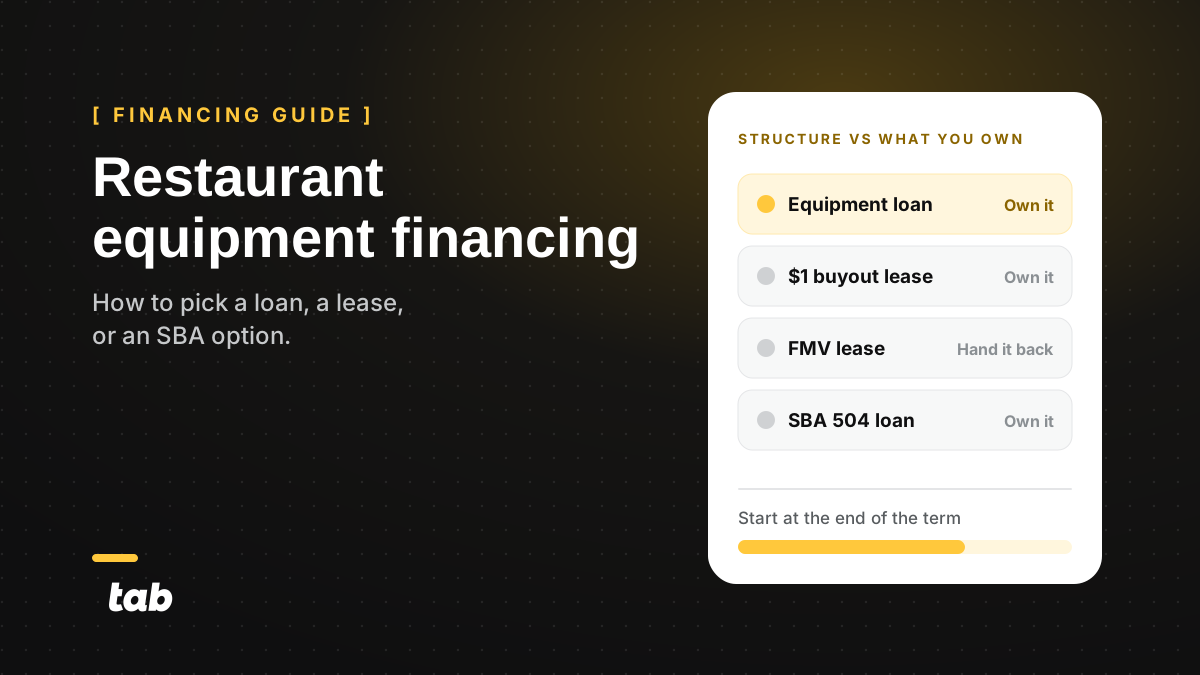


The structure you pick decides three things: what you own at the end, how fast the money lands, and how much of the true cost hides in fees instead of the rate.
Contents
- Pick your structure by what you want at the end of the term
- Section 179 and 100% first-year depreciation
- Used equipment usually qualifies
- Clean paperwork funds in days
- The fees that move the real cost
- What lenders ask for
- When financing is the wrong move
- Soft costs, broken equipment, and where SBA rates come from
- Pay eligible equipment costs with Tab
Pick your structure by what you want at the end of the term
Start at the end of the term and work backwards. If you will still be running that dish machine in year eight, an ownership structure wins.
If the equipment will be obsolete or beaten up before the term ends, renting the use of it is the honest option.
| What matters | Equipment loan | $1 buyout lease | FMV lease | SBA 7(a) | SBA 504 | Vendor financing | Sale-leaseback |
|---|---|---|---|---|---|---|---|
| Who owns it at the end | You | You, for $1 | Lessor, unless you buy it | You | You | You | The lessor |
| Term vs equipment life | Match term to useful life | Same | Term ends before the life does | Long terms available | Built for 10+ years of remaining life | The supplier sets it | You keep using it |
| Speed to fund | Days | Days | Days | Weeks | Weeks | Days | Weeks |
| Down payment | Negotiable | Often first and last payment | Often first and last payment | The lender decides | Borrower injection required | Sometimes none | None, you receive cash |
| Used equipment | Common, with proof | Common | Rare on older gear | Ask the lender | Ask the CDC | Usually new only | You already own it |
| Soft costs | Ask what is eligible | Ask | Ask | Installation is a listed use | Project costs, ask the CDC | Usually equipment only | Not applicable |
| Prepayment | Ask for the payoff rule | Often a set payoff | Usually not allowed | SBA fee rules apply | Penalty in the early years | Ask | Ask |
| What to ask your CPA | How to treat the purchase | Whether it counts as a purchase | Whether payments are rent | Same as a purchase | Same as a purchase | Loan or lease, which is it | Both the sale and the rent |
| Fees to price in | Ask for the APR | The purchase-option fee | Return and residual costs | The SBA guaranty fee | CDC and servicing fees | Whether the quote is an APR | Appraisal costs |
| Paperwork | Moderate | Moderate | Moderate | Heavy | Heaviest | Lightest, at checkout | Appraisal driven |
Use financing for a large capital purchase that needs a loan or lease. When the vendor accepts Visa and the cost fits your approved card limit, Tab can pay directly for equipment, delivery, installation, repairs, replacements, and supplies. The receipt, restaurant, and accounting trail stay together, and the purchase earns unlimited 1% cash back.
The 7(a) versus 504 question comes down to what else is in the project. SBA 7(a) lists purchasing and installing machinery and equipment among its permitted uses, and it can sit alongside working capital in one deal. (SBA)
504 is narrower and cheaper on long-life assets. It is built for major fixed assets with at least 10 years of remaining useful life, which fits a hood system or a walk-in and does not fit a POS refresh.
504 money cannot go toward working capital or inventory, so a hood system plus opening payroll is two conversations, not one. It also runs through a certified development company alongside your bank, which is part of why it takes weeks.
Supplier programs sit at the other end of the effort scale. WebstaurantStore's LEAF program runs from $3,000 to $250,000 on 12 to 60 month terms, applied for at checkout. (WebstaurantStore) KaTom runs its own financing page as well.
That convenience is real, and it also means you are comparing one offer instead of three. A checkout approval is not evidence that the terms are good.
Sale-leaseback is the outlier. You already own the equipment, you sell it to a lessor, and you rent it back for cash today.
It solves a cash problem, not an equipment problem, and it costs you the asset. Groups reach for it when a slow quarter meets a payroll cycle, which is exactly when the pricing is worst.
Total cost worksheet
Rates are the smallest part of this. Fill in seven lines for every quote and compare the bottom one.
| Line | What to write down |
|---|---|
| Principal | The vendor quote after trade-in and deposit |
| APR or factor rate | Convert any factor rate to an APR before you compare |
| Term | Months, and the date payments actually start |
| Fees | Doc, origination, filing, and inspection |
| Prepayment penalty | Yes or no, plus the payoff formula |
| End-of-term residual | The buyout figure, or $1 on a $1 buyout |
| Total cash out | Every payment, every fee, plus the residual |
A factor rate of 1.25 is not a 25% APR. Ask for both numbers in writing.
The start date line matters more than it looks. If payments begin at delivery rather than at acceptance, you are paying on a hood that has not passed inspection yet.
The purchase is one decision. The costs after it are the next job.
Tab is not a lender. After approval, use it to control delivery, installation, repairs, and which restaurant pays each charge.
Section 179 and 100% first-year depreciation are two different deductions
For tax years beginning in 2026, the maximum Section 179 deduction is $2,560,000, and it starts phasing out once Section 179 property placed in service that year passes $4,090,000. (IRS Publication 946)
Separately, current law provides a permanent 100% additional first-year depreciation deduction for qualified property acquired after January 19, 2025. Taxpayers may elect 40% or 60% instead for the first tax year ending after that date. (IRS)
The IRS issued guidance on how the amended deduction works in Notice 2026-11, including how the acquisition date is determined.
Two dates decide most restaurant cases. Acquisition is when you contracted for the equipment. Placed in service is when it is installed and actually usable, which on a hood or a walk-in is a different month than the invoice date.
An FMV lease may not produce a purchase deduction at all, because you did not buy anything. Those payments are usually treated as rent instead, deducted as they are paid, which is a slower and steadier tax story than a large first-year write-off.
Bring the vendor quote and the signed agreement to your CPA before you file. Nobody at the equipment dealer is responsible for your return, and none of these deductions are automatic.
The election detail, the timing rules, and how this lands for a restaurant specifically sit on the Section 179 for restaurants breakdown, which is the better read once you have a signed deal.
Used equipment usually qualifies, but each lender sets its own proof
Used gear is financeable. The difference is what the lender wants to see before it wires money.
Axiant's published guidance says used equipment financing may require additional verification such as photos, serial numbers, or inspection reports. (Axiant)
NerdWallet's primer on used equipment financing adds that some lenders cap the age of the equipment they will fund at all.
Treat both as examples of what lenders ask, not as the market's rulebook.
On an auction or private-party buy, ask up front:
- Who proves the seller owns it? A bill of sale and proof of ownership are the usual asks on a private sale, and an auction house invoice is not always enough on its own.
- Is there an age cap? Some lenders decline past a certain model year, and that cap is theirs, not an industry rule.
- What is it worth if you stop paying? Resale value drives terms on used gear more than your credit score does, which is why a common brand often finances better than a rare one.
- Does the seller still owe money on it? An existing lien has to be released before your lender will fund, and chasing that release is the step that blows the timeline.
- Who moves it, and when? Auction lots usually have a removal deadline, and a lender that funds after pickup leaves you covering the rigging cost yourself.
A bigger deposit or a shorter term sometimes moves a marginal used deal. Neither is a guarantee, and no lender owes you an approval because you offered one.
Clean paperwork funds in days, missing paperwork stretches it to weeks
Axiant publishes estimates of 24 to 72 hours for initial approval, 3 to 7 business days for underwriting, and 5 to 10 business days to fund when documentation is clean. Those are one finance marketplace's ranges, not a promise or a market standard. (Axiant)
SBA files run longer than that. Your lender, your equipment, your entity structure, your insurance agent, and your vendor all move the number.
Axiant names six sources of post-approval delay: unfulfilled funding conditions such as insurance and the UCC search, slow signing of closing documents, vendor paperwork, insurance delays, a final invoice that does not match the original quote, and the lender's funding queue. (Axiant)
Two of those are yours to control. Ask your insurance agent for the certificate the day you sign, and make the vendor's final invoice match the quote line for line, including the model number.
A mismatch of one digit in a model number sends the file back to underwriting, and the queue does not hold your place while you fix it.
The fees that move the real cost more than the rate does
The rate is the number the salesperson leads with. These are the ones that change what you actually pay.
- Origination and documentation fees. Charged at signing, quoted separately from the rate, and easy to miss on a term sheet.
- Interim rent. Payments that start at delivery instead of at acceptance, which is money spent before the hood is even inspected.
- Property tax pass-throughs. On leases, the lessor owns the asset and bills you for the tax it pays, often as a lump once a year rather than inside the monthly payment.
- End-of-term residual. On an FMV lease this is the real cost of ownership, and it is not set until the end unless you negotiate it now.
- Return and redelivery costs. An FMV lease can require the equipment back in working order, uninstalled and shipped at your expense, which is a real bill on a walk-in.
- Prepayment penalties. Ask for the payoff formula in writing, not the policy. "We usually work with you" is not a formula.
- Blanket UCC liens. A lien on the specific equipment is normal. A lien on every business asset is a different deal, and it can block your next loan.
Equipment finance agreements differ materially on legal classification, warranties, acceptance, end-of-term duties, and security interests, which is why the same word "lease" covers very different contracts. (ELFA)
ELFA's own explainer on why clauses exist is worth ten minutes before you sign, because most of these terms are negotiable at proposal stage and none of them are afterward.
Questions to ask before signing: What is the APR? What is every fee? What is my payoff at month 24? What exactly does your lien cover? What am I obligated to do at the end of the term?
Delivery tips and install-day supply runs are usually separate from the financing. Put them in the operating budget unless the lender confirms they are included.
What lenders ask for, and why your list will not match your neighbor's
The SBA says plainly that the contents of the loan application vary depending on the size of the loan and the lender's processing method. (SBA) Private lenders vary just as much.
On the SBA side, Form 1919 collects the applicant, the owners, the loan request, existing debt, and any other government financing, which is a useful preview of what a bank will ask for even on a non-SBA deal.
Assemble these before the first call, so you spend that call answering questions instead of hunting files:
- Owner and entity information. Legal name, EIN, ownership percentages, and the operating agreement for each LLC in the deal.
- Financials. Recent business tax returns, a P&L, and a balance sheet.
- Bank statements. Usually the most recent few months, per operating account.
- Existing debt. Balances, payments, and any liens already filed against the business.
- The vendor quote. Itemized, with the model number, and matching what you will be invoiced.
- Equipment details. Make, model, serial number, and condition on used gear.
- Proof of insurance. Required before funding on most secured deals, and the certificate usually has to name the lender as loss payee.
Multi-entity groups lose the most time at this step, because the bank statements sit in four places and nobody owns the folder. Decide who owns it before the lender asks twice.
After the equipment is running, Tab keeps card receipts coded to the right restaurant and company. QuickBooks Online connects directly on the free Base plan; other ledgers can use a customizable CSV.
Capitalizing the asset and running the depreciation schedule afterward is a bookkeeping job, and it is covered in the restaurant bookkeeping software guide.
When financing is the wrong move
Three situations where the answer is no:
- Pay cash when the purchase will not strain payroll, sales tax, rent, or your reserve. A $9,000 ice machine on a healthy balance sheet does not need a five-year contract attached to it.
- Repair or rent when the equipment is temporary. A short remaining lease on the building, seasonal capacity, or a unit near the end of its useful life all point away from a long term.
- Delay when the equipment does not solve a measured bottleneck. If you cannot name the hours, the waste, or the covers it fixes, the purchase is a want.
Put the monthly payment next to the realistic savings the equipment produces in labor, waste, capacity, or maintenance. If the payment is bigger in a conservative sales case, the deal is not ready yet.
Run that comparison on your slowest quarter, not your best one. Every equipment purchase pencils out against a good August, and the payment is still due in February.
A tax deduction is not proof that a purchase is affordable. It reduces tax on money you already spent.
This week: pull the documents above, get an itemized vendor invoice, and book two calls, one with a lender and one with your CPA.
If the equipment is supposed to reduce waste or portion cost, the food cost calculator puts the current gap into monthly dollars before you model the payback. The restaurant management software guide covers the systems that can track the result after installation.
Soft costs, broken equipment, and where SBA rates come from
Sometimes, and never automatically. Axiant notes that working capital loans cover soft costs equipment financing typically will not. (Axiant)
Send your lender the itemized quote and ask which lines are eligible before you assume the hood install is included in the number. Permits and buildout usually sit outside an equipment deal entirely.
Read who carries that risk in your agreement. Contracts differ on warranties and on acceptance, which is the moment you formally sign off that the equipment works.
Once you accept, the payment obligation usually stands on its own, separate from any dispute with the vendor. Ask your lender to walk you through the acceptance clause before you sign it, not after the compressor fails.
Variable-rate SBA loans are commonly tied to a base rate like Prime, so the payment can move after closing. Prime sat at 6.75% in mid-July 2026. (FRED)
Ask your lender whether your quote is fixed or variable, what it is indexed to, and how often it can reset. On a seven-year term, that answer is worth more than a quarter point off the starting rate.

James writes from Tab's work with restaurant groups choosing cards, fixing missing receipts, coding spend, and closing the books. Tab brings cards, accounts, receipt automation, and Andy AI into one restaurant back office.


