



On this page
Every week, another restaurant tool puts "AI" on the box. Some save hours or catch money leaks. Others are the same dashboard with a higher price. This guide shows what actually works in a restaurant.
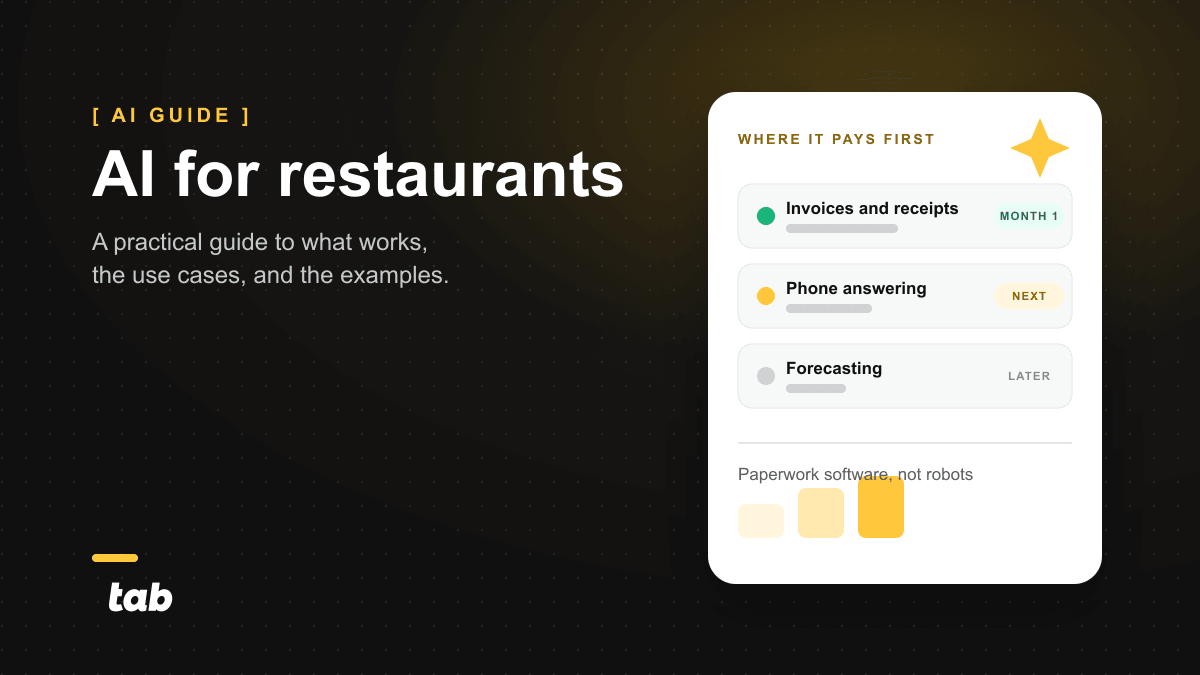
Start with invoices and books. AI can read every line, collect receipts, and code spend before close. The rest matters only when it fixes a clear daily problem.
The honest map10 ways restaurants use AI today
Here is what each job does, how restaurants use it, and where the payoff shows up. Invoices and books usually pay off first.
Invoices and purchasingTab does this
Reading line items, catching price creep, recovering rebates
- Read every invoice line and match it against the agreed price
- Flag price creep and surprise surcharges the week they hit
- Chase short deliveries and unapplied credits back to your account
- Surface the rebates and GPO dollars you are already owed
.png)





Bookkeeping automationTab does this
Coding transactions, capturing receipts, reconciliation
- Capture and read receipts the moment the card is used
- Code transactions and tag the right location automatically
- Sync clean books into QuickBooks so the close starts from real numbers
- Chase down the missing receipts before they go cold
-min.png)
Demand forecasting and scheduling
Predicting covers, ordering and staffing to real demand
- Forecast covers and sales by daypart, not just by day
- Order product to real demand and cut the panic buy
- Build schedules that match the shifts that will actually be busy
- Layer in weather and local events to sharpen the call

Inventory and waste
Theoretical vs actual usage, variance, shrinkage
- Compare theoretical against actual usage line by line
- Flag the shrinkage and over-portioning driving food cost up
- Cut the 86 count by catching what runs short early
- Turn a messy count into a variance report you can act on

Marketing and review replies
Drafting replies, social posts, menu descriptions
- Draft review replies fast in the operator's own voice
- Spin up social posts and promos for the week ahead
- Write menu descriptions that read like your restaurant
- Turn a stack of guest reviews into replies before they age

Phone answering and voice ordering
AI voice agents that catch calls, take takeout orders, book tables
- Capture the missed calls that were walking to a competitor
- Take simple takeout and reservation calls around the clock
- Answer questions on hours, location, and specials instantly
- Route the tricky calls to a human instead of dropping them

Menu pricing intelligence
Watching plate costs and demand to suggest price moves
- Refresh plate costs the moment an ingredient price moves
- Flag the dishes that slipped under your margin target
- Model what a price change does before you commit to it
- Spot the high-margin items worth pushing on the menu

Labor compliance monitoring
Watching schedules and time clocks for overtime and break rules
- Flag overtime before it lands on the payroll run
- Catch missed or late breaks the moment they occur
- Track fair-workweek and predictive-scheduling exposure
- Warn managers before a labor rule turns into a fine

Energy and equipment monitoring
Sensors on coolers and HVAC that flag drift before it costs you
- Alert the manager the moment a walk-in drifts warm
- Save the product before an overnight failure spoils it
- Watch HVAC and line equipment for early signs of drift
- Log temps automatically for the health inspector

Guest personalization and loyalty
Segmenting guests, timing offers, predicting churn from POS data
- Recognize repeat guests and reward them automatically
- Time win-back offers to guests who have gone quiet
- Tailor promos to real order history, not a blast
- Spot your highest-value regulars and treat them like it
These are the common uses restaurant teams put each tool to, not a claim that every product does all of it. Everything stated about Tab comes from Tab's own published product and pricing.
The one line to remember
Most of these tools optimize what you might do next. Only the top two, invoices and books, can hand you back money you already lost. That is why they pay off first.
Where restaurants quietly lose more than $25,000 a year
This is the part of the house AI was built for. It is not glamorous. It is the slow bleed operators call death by a thousand paper cuts. One invoice at a time, the margin walks out the back door, and no one has time to catch it by hand.
The slow leaks that never make the P&L in time
- Price creep. The same item from the same vendor inches up week after week until you are paying double and never noticed the day it happened.
- Surprise surcharges. New fuel fees, delivery fees, and "market adjustments" show up on the invoice and quietly stick.
- Short deliveries. You paid for the full case, got most of it, and the credit was promised on the phone.
- Credits that never post. The rebate you were owed and the refund for the short order simply never show up.
- Too many invoices to police. Ten to fifteen invoices a week across produce, meat, dry goods, and three delivery apps. Nobody has a Sunday long enough to check them all.
None of this is one big theft you can catch. It is a hundred small ones. That is exactly the shape of problem AI is good at, because a model can read all of it at once, every day, without getting tired or skipping a slow week.
How an AI purchasing analyst actually works
Strip away the marketing and the job is simple. An AI purchasing analyst reads the paperwork you do not have time to read, compares it against what you should be paying, and flags the gap so someone can claw the money back.
Reads
Every invoice line and every vendor agreement, 24/7, including the data trapped in PDFs and vendor portals.
Flags
Price creep on repeat items, overcharges against your agreed rate, short deliveries, and credits that were never applied.
Recovers
The rebates and overpayments you are owed, worked in the background and deposited back to you month after month.
The receipts and card data are the other half. Before an analyst can find an overcharge, the spend has to be captured cleanly in the first place, tied to the right card, vendor, and location. That capture is live and free today. Here is what it looks like in the product.

.png)
The receipt gets chased at the swipe
Right after a card is used, Tab prompts the cardholder for the receipt while the purchase is still fresh, with the vendor and location already attached. The invoice that would have landed in the wrong month lands coded instead.
.png)
Every card is scoped before money moves
Each card carries its own limit, location, and vendor trail, so a $40,000 food budget stays a $40,000 food budget. Real vendors like Brothers Produce and Houston Meat Distributors show up already tagged, not as a mystery charge at month-end.
The pricing is the honest part, and it is short. The card and the receipt and expense automation are free on the Base plan. Andy AI, the purchasing analyst that reads your invoices for overcharges and rebates, is in the Pro plan at $150 a month per location. No credit check is required to get the card.
Start capturing the spend for free, add Andy when you want the recovery
Managers swipe a card you control, Tab chases the receipt and tags the location, and the transaction lands coded in QuickBooks. Base is free, and most teams are set up in about one week.
What AI will not fix, no matter what the ad says
This is the section most vendor pages leave out. AI is a tool, not a turnaround. If a tool promises to fix any of the things below, it is selling you the sticker, not the software.
A menu that does not sell
AI can price a dish to the penny. It cannot make people want to order it. That is your concept and your kitchen.
Bad staffing or a bad hire
Software does not run your floor or coach your team. A forecast cannot replace a good manager on a Friday night.
A bad location or broken model
No model fixes rent, foot traffic, or a concept that does not work. It can only make a working business cleaner.
Your bookkeeper or accountant
AI cleans and speeds the inputs. A human still owns the close, the taxes, and the calls that need judgment.
Your judgment
It flags the overcharge and the price creep. You still decide whether to call the rep, switch vendors, or let it ride.
Messy data, magically
Garbage in is still garbage out. If receipts are missing and counts are guesses, AI just gives you a confident wrong answer faster.
What it can do
Give a working restaurant back the hours it spends on paperwork, and hand back some of the margin it did not know it was losing. That is the honest promise. Anything bigger is a sales pitch.
Get the same honest read on your own setup
Bring last month's invoices. You will hear where AI genuinely helps your operation and where it does not, before you spend a dollar on it.
How to start without getting burned
The category is full of demo walls, hidden pricing, and tools built for a warehouse and painted to look like a restaurant. Five rules keep you out of that trap.
Start where the money leaks
Invoices and books first. That is where AI pays for itself, so it is where you should spend your first dollar and your first hour. Forecasting and marketing can wait.
Demand a free tier or a real price on the page
If you cannot see a price without booking a sales call, someone made that choice for a reason. A free plan or a printed price is a sign the tool can stand on its own.
Skip the demo wall when you can
You should be able to try the thing, not just watch a rep drive it. Self-serve signup is a signal the product works without a salesperson holding your hand.
Check the vendor actually knows restaurants
Order guides, GL codes, locations, and vendors like Sysco should be native, not bolted on. A horizontal expense tool with a restaurant logo on the homepage is still a horizontal expense tool.
Expect humans when it breaks
Ask who picks up before you sign. Tab has live chat and email support staffed by real people in the US and Canada, and most teams are set up in about one week.
Onboarding
Answer a few questions about your restaurant.
Step 1Cardholder Agreement
Sign the standard cardholder terms.
Step 2Link Bank Account
Securely connect your bank to fund and sync.
Step 3Live in about one week
Free Base plan, no credit check, ready for your first billing cycle.
Get started freeHave someone map week one with you
A Tab specialist goes through your locations, entities, cardholders and accounting handoff, so you know exactly what the first week looks like before you commit.


