


On this page
- Franchise or open your own next unit
- Seven gates to clear before you franchise
- Prove your numbers before Item 19
- Build the legal package with counsel
- Turn your operations into a copyable system
- Recruit franchisees who fit the model
- Set up training and field support
- Standardize money and tech across locations
- What drives your timeline and cost
- Franchise questions operators actually ask
- Your next move this week
A prospect must hold that disclosure document for at least 14 calendar days before they sign or pay.
A busy dining room proves demand, not a transferable system. You are selling instructions somebody else can follow in a town you have never visited.
Heads up
Franchising is regulated under federal and state law. This is background, not legal or accounting advice. Bring in a qualified franchise attorney and accountant before you offer anything.
-
Readiness
- Prove repeatable unit economics
- Remove owner dependence
- Build a management bench
- Lock vendor consistency
-
Legal and FDD
- Franchise attorney drafts the 23-item FDD and franchise agreement
- Entity and trademark cleanup
- Audited financials for Item 21
- State registration or notice filings where required
-
First franchisee
- The disclosure waiting period runs before any signature or payment
- Validation calls
- Site approval
- Build and open
-
Support systems
- Training program
- Opening team
- Field visits
- Reporting cadence
- Vendor programs
-
Scale
- Annual FDD update within 120 days of fiscal year end
- Quarterly revisions on material change
- Support headcount added before units are sold
Franchise or open your own next unit
Franchising uses the franchisee's capital and moves operating risk to their balance sheet. Company-owned growth keeps the profit, risk, and daily control with you.
There is no "franchise-lite." Federal law defines a franchise by three elements: the other operator gets rights to a business tied to your trademark, you exert or can exert significant control over how they operate or give them significant assistance, and they make a required payment to you.
Hit all three and it is a franchise no matter what the contract is titled. Calling it a license does not move you outside the rule.
The narrow federal carve-out is small: required payments under $735 in the window from before opening through six months after, plus a handful of other exemptions your attorney checks.
If you are still weighing the model itself, the restaurant expansion strategy guide is the better first read because it compares corporate units, partnerships, and franchising on capital and control before any of this legal work starts.
| What you are trading | Company-owned unit | Franchised unit | Licensed or managed deal |
|---|---|---|---|
| Who funds the build | You | The franchisee | Depends on the deal |
| Who takes operating risk | You | The franchisee | Usually you |
| Your revenue per unit | Full profit | Royalty and fees | Fee or profit split |
| Speed of growth | Limited by your capital | Limited by qualified candidates | Case by case |
| Control of daily operations | Total | Contract and manual only | Varies |
| Federal regulation | None specific | FTC Franchise Rule applies | Franchise Rule still applies if the three elements are met |
| Biggest failure mode | Runs out of cash | Sells units it cannot support | Assumes a label avoids the rule |
Seven gates to clear before you franchise
Franchise programs usually fail because the concept was never repeatable, not because the FDD was formatted badly. Work the gates below in order.
The gate that ends the most conversations is owner dependence. If the store's numbers dip when the owner takes two weeks off, there is no system to sell yet, only a job that pays well. Sage's franchising guide sets a plain bar before you start: consistent profitability over at least two years.
Gate six is easy to underestimate. Your unit economics can work while the franchisee's do not, because they also carry royalty, marketing contributions, and debt service. Model their P&L, not yours.
-
01
Repeatable unit economics
Evidence to collectTwo-plus years of unit-level P&Ls on one chart of accounts, prime cost by periodRed flagOne flagship unit carries the averageNext actionRebuild reporting so every unit reports the same lines -
02
Transferable operations
Evidence to collectWritten manual, prep specs, par sheets, open and close checklistsRed flagRecipes live in the chef's headNext actionDocument and test with a manager who did not write it -
03
Management bench
Evidence to collectA GM who runs the store while the owner is away, a trainer who is not the ownerRed flagOwner approves every order and every scheduleNext actionHire and promote before you sell, not after -
04
Supply and vendor consistency
Evidence to collectDistributor agreements, pricing sheets, backup vendors by regionRed flagOne local supplier no franchisee can reachNext actionNegotiate regional or national programs -
05
Brand and legal readiness
Evidence to collectRegistered trademarks, clean entity structure, audited financial statementsRed flagThe mark is unregistered or contestedNext actionTrademark counsel first, franchise counsel second -
06
Franchisee economics
Evidence to collectA model that pays a working owner after royalty, marketing, rent, and debtRed flagThe model only works at your rent and your labor rateNext actionRe-model at market rent and a hired GM -
07
Support capacity
Evidence to collectA named opener, a trainer, and a field visit scheduleRed flagThe plan is "call me anytime"Next actionStaff support before the first sale, not after the tenth
Prove your numbers before Item 19
Item 19 is where financial performance claims live. It is optional, but any claim you include needs a reasonable basis, written support, the outlets and dates used, and the percentage of stores that met it.
That is why inconsistent books block a franchise program. First standardize:
So the work is unglamorous and it comes first:
- One chart of accounts across every unit, with the same GL codes for the same purchases.
- The same period definitions everywhere, so a four-week period at one store is not a calendar month at another.
- Prime cost tracked the same way, including how you treat manager salary, delivery fees, and comps.
- Clean separation between four-wall performance and corporate overhead you will not charge a franchisee.
No seller may make a claim that contradicts the FDD. Build the support with restaurant budgeting and menu engineering before a broker quotes numbers.
Legal buildBuild the legal package with counsel
A franchise attorney drafts the legal package, an accountant audits the financials, and you supply the operating facts.
1) Draft the FDD
The FDD has 23 numbered items. Operators spend the most time on Item 7's initial investment, Item 19's performance claims, Item 20's outlet history, and Item 21's independently audited financials. If you have never had an audit, start early.
2) Write the franchise agreement
The agreement sets territory, term, renewal, royalty, marketing contribution, transfer, default, and termination. Write it for the disagreement you may have in year seven.
3) Lock the entity and the trademark
Confirm the mark is yours and clean, and separate the franchising entity from the company operating your restaurants where counsel recommends it.
4) Register or file where the state requires it
Some states require FDD registration; others require notice filings. Your attorney should map the states you plan to sell in against the FTC's federal baseline.
5) Run the disclosure clock every time
The 14-day wait cannot be waived. Calendar the annual update and material-change amendments so nobody sells from a stale document.
Turn your operations into a copyable system
The FDD must disclose the manual's table of contents and page counts, unless the prospect can inspect it before buying. Build it for a stranger on day one, then test it with a manager who did not write it.
-
01Recipes and specs
Yields, plate costs, and build photos.
How you prove it transfersA cook who has never worked your line plates it to spec from the page alone. -
02Food safety and compliance
Handling standards, logs, and the local health requirements that change by market.
How you prove it transfersA new market passes inspection on the manual, not on a phone call to you. -
03Opening playbook
Site criteria, build timeline, equipment list, pre-opening hiring and training calendar.
How you prove it transfersA store opens on the calendar without you flying out. -
04Labor model
Staffing by daypart and volume.
How you prove it transfersA franchisee schedules to your standard rather than to their nerves. -
05Local marketing
Approved assets, store-level tactics, and the rules for using the brand.
How you prove it transfersA franchisee runs a promotion without redrawing your logo. -
06Reporting cadence
What gets sent to you, in what format, on what day.
How you prove it transfersPeriod numbers arrive on the same chart of accounts from every unit.
Item 8 discloses required suppliers and revenue you receive from their purchases. Build regional backups and written specs before promising pricing, using the vendor management guide. Standardize the POS, inventory, and scheduling stack with the restaurant management software roundup.
RecruitingRecruit franchisees who fit the model
Item 20 makes outlet history and departed franchisee contacts public. A bad sale today becomes a validation call for next year's buyer. Recruit for year-five operators, not a full pipeline:
- Restaurant operating experience, or a funded partner who has it and will be on site.
- Capital that survives a slow first year. Sage suggests net worth of two to three times the investment and liquid capital of one third to one half.
- Willingness to run your system, tested by asking what they would change and listening for how much.
- Validation calls encouraged, not controlled.
Be clear about ongoing costs. Sage puts typical royalties at 4% to 8% of sales and marketing contributions at 1% to 4%.
SupportSet up training and field support
The FDD requires a training table with subjects, classroom and on-the-job hours, locations, and pre-opening obligations. Whatever you disclose, you owe.
Build three things before the first sale:
- An opening team with a named owner and checklist.
- A training path with hours, sign-offs, and a certification standard for the franchisee, their GM, and their trainers.
- A field visit schedule with a standard evaluation form, so visits produce the same feedback in Ohio and Arizona.
Support capacity limits sales. Early units often cost more to train, open, and visit than their royalties fund, so staff support before signing the next group.
Systems standardStandardize money and tech across locations
Every franchised unit adds an entity, a bank account, a set of cards, and a person who buys things. Standards written after the fact never get adopted.
Name them in the manual now: POS, accounting platform, inventory system, purchasing rules, card issuance, receipt policy, and who gets access to what.
Accounting is the one to decide first. Corporate stores and franchised stores should report on the same chart of accounts, and QuickBooks for restaurants walks the setup that keeps location and entity coding consistent as the count grows.
For where automation genuinely helps a small back office, AI for restaurants covers what these tools do today without the hype.
Where Tab fits when every unit is its own entity
Tab works alongside your POS and your accounting platform rather than replacing either one. The POS rings sales. The ledger stores what happened. Tab handles the buying in between, which is the part that gets messy the moment a group runs several entities and bank accounts.
What that looks like:
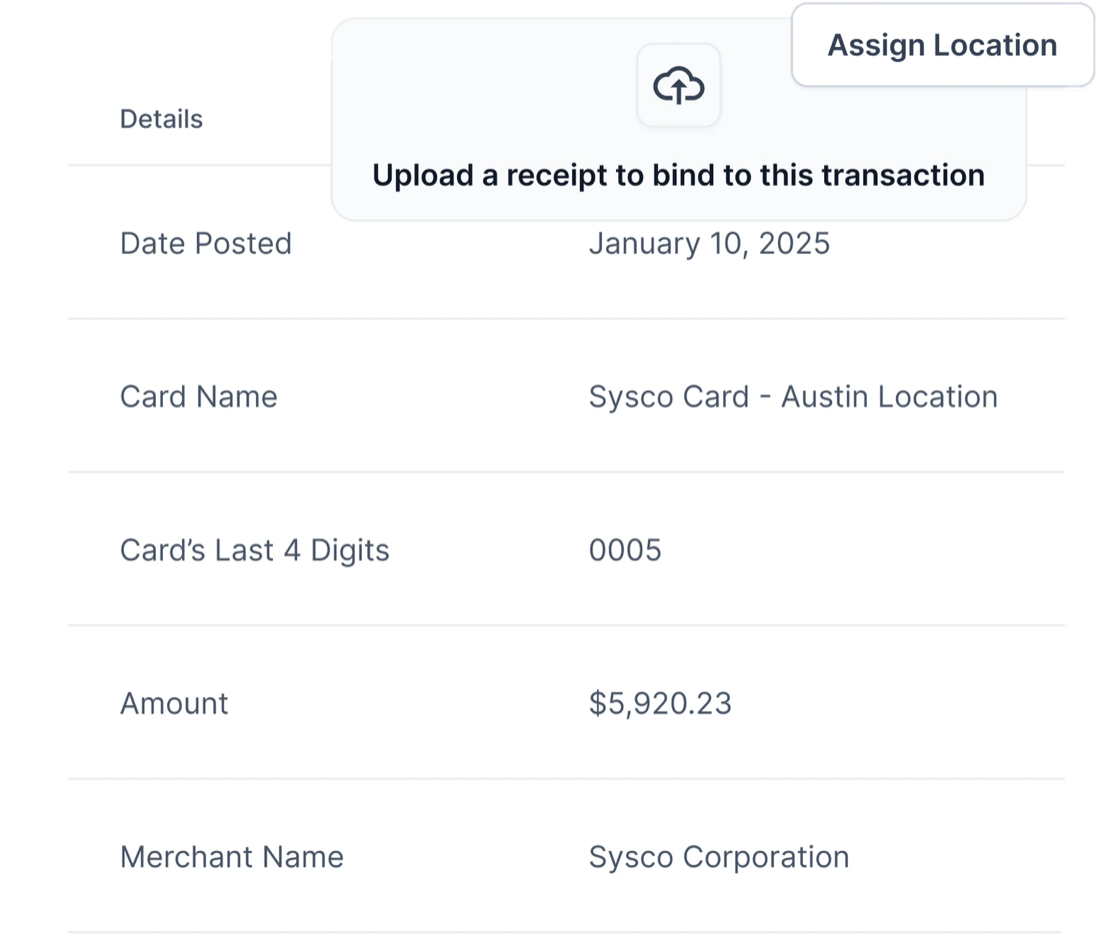
- Set card limits by person and location, with unlimited virtual and physical cards and no credit check.
- Collect receipts by text in 90 seconds on average, then add the location, note, and multi-location split.
- Keep each entity's cards and accounts organized, then send coded data to QuickBooks Online or another ledger by CSV.
 Location tag
Location-scoped card
Location tag
Location-scoped card
Setup takes about one week. Base is free, Pro is $150 per month per location, and groups with 5+ locations can request custom pricing or a partnership program.
Budget and timelineWhat drives your timeline and cost
Sage estimates $50,000 to $150,000 for FDD and agreement work and $100,000 to $250,000 or more for a full system build. These are planning ranges, not quotes.
Four things move the number: how many states you register in, whether your financials have ever been audited, how much of the manual already exists, and how clean your trademark is.
A franchisee may still need 6 to 18 months to open, so discuss build-out capital early and share the restaurant equipment financing guide.
| Line item | What it covers | Cost |
|---|---|---|
| One-time build | ||
| FDD and franchise agreement drafting | Attorney work, before any offer | $50,000 to $150,000 (Sage estimate) |
| Full franchise system build | Legal, manuals, brand assets, training build, consultants | $100,000 to $250,000 or more (Sage estimate) |
| Trademark registration | Federal filing and prosecution for the marks you license | Varies by mark and counsel |
| First audited financial statements | Required for FDD Item 21, by an independent CPA | Varies by auditor and entity complexity |
| Initial state registration | Only in states that require registration before offering | Varies by state |
| Every year after | ||
| Annual FDD update | Revised document required within 120 days of fiscal year close | Attorney time each year |
| Quarterly revisions | Required after any material change to disclosed information | Attorney time as needed |
| State renewals | Annual in registration states | Varies by state |
| Audited financials | New audit each fiscal year for the updated Item 21 | Varies by auditor |
| Field support payroll | Openers, trainers, field consultants | Salary per head, added before units are sold |
Franchise questions operators actually ask
There is no federal minimum. One store that runs clean without the owner is stronger evidence than three the owner personally holds together.
The FDD is the 23-item disclosure given before a sale. It covers fees, investment, legal history, territory, trademarks, obligations, outlet counts, and audited financials.
Only in Item 19, with a reasonable basis and written support. Sales calls cannot contradict the FDD.
It depends on the states, trademarks, books, and how much of the system is already documented. The ranges above are for planning.
Labels do not decide it. Trademark rights, significant control or assistance, and a required payment generally make it a franchise. Have counsel review the deal.
Your next move this week
Pull the last 24 months of unit-level P&Ls and put them on one chart of accounts. If you cannot do that in an afternoon, that is the project, not the FDD.
Then book two calls: a franchise attorney to scope the disclosure work in the states you actually want, and a CPA to price the audit. Both conversations are cheaper than discovering the gap after you have taken a deposit.
And keep the disclaimer in front of you. Franchise rules vary by state and change over time, so get qualified legal and accounting advice for your own situation before acting on any of it.


