


Get the real number, find the failed branch, then run the fix that matches it.
Contents
- Get your real number first
- Find where the gap starts
- 12 ways to cut restaurant food costs
- Recount the expensive stuff
- Check invoice prices against your agreement
- Chase the credits and rebates you already earned
- Tighten receiving and substitutions
- Track yield on your big-ticket proteins
- Standardize portions at the station
- Log prep, spoilage, and plate waste separately
- Cut the emergency grocery runs
- Simplify low-volume ingredients
- Rebuild the menu around margin and mix
- Audit discounts, comps, and voids
- Give food cost one weekly owner
- Your 30-day food cost plan
- Where Tab fits around this
- Questions operators ask about food cost
Get your real number first
Food cost % = (beginning inventory + purchases - ending inventory) / food sales x 100.
That's period food cost, and it only works if the pieces line up. Count on the same weekday at the same hour, close the period on the same day your sales report closes, and include every purchase, including the card run somebody made on Saturday.
Food cost percentage, worked
($18,400 + $52,000 - $16,900) / $186,000 x 100= 28.8%
- Beginning inventory$18,400
- Purchases$52,000
- Ending inventory$16,900
- Cost of food used$53,500
- Food sales$186,000
Actual food cost28.8%
- Your target 27.5%
- Gap 1.3 points
- Gap in dollars for the period $2,418
Run one clean period before changing anything. Then compare it with your target, built from your P&L: 100% minus labor, occupancy, other operating costs, and required profit.
42% of operators said they were not profitable in 2025. A target borrowed from another concept can make you cut the wrong line.
If you want the math done for you, the free restaurant food cost calculator runs period cost and recipe cost in the browser, which is faster than rebuilding a spreadsheet every month.
Find where the gap starts
Your food cost percentage is one number sitting on top of five separate jobs. When it moves, one branch moved and the other four are innocent.
Where the money leaks
-
What you paid
- Vendor price creep
- Off-contract buying
- Emergency grocery runs
-
What arrived
- Short deliveries
- Unapproved substitutions
- Wrong pack size
- Credits never claimed
-
What was used
- Prep waste
- Spoilage
- Over-portioning
- Yield loss
- Theft
-
What was sold
- Comps
- Voids
- Discounts
- Menu mix shift
-
What was recorded
- Missing invoices
- Card purchases never coded
- Wrong period
Every one of these shows up as the same symptom: food cost percentage up.
Each branch has one check that settles it. Run them in order and stop at the first one that fails.
| Branch | The check | Where the data lives | Who owns it | First action |
|---|---|---|---|---|
| What you paid | Invoice price vs your agreed price on your top 20 items by spend | Vendor portal, invoices, contract or GPO sheet | Owner or controller | Pull four weeks of invoices and price-check the top 20 |
| What arrived | Case count and weight vs the invoice, plus any substitution | Receiving log, scale, delivery tickets | Receiving manager | Weigh one protein case per delivery for two weeks |
| What was used | Theoretical usage from recipes vs actual usage from counts | POS mix report, recipe specs, inventory counts | Chef or kitchen manager | Yield-test your two most expensive proteins |
| What was sold | Comps, voids, and discounts by employee and reason code | POS reports | GM | Read last week's comp report line by line |
| What was recorded | Every purchase in the period, invoices and card charges both | Accounting system, card statements, receipts | Bookkeeper or controller | Match card charges to receipts for the last 30 days |
Branch three is actual versus theoretical: what recipes and sales say the kitchen should have used versus what counts and purchases say it used. That is the gap portion and waste work can move.
The last branch is the one that fools people. If a $2,100 produce invoice landed in the wrong period, or four club-store runs never got coded to the restaurant, your food cost is wrong and your kitchen is fine. Check the paperwork before you call a meeting.
12 ways to cut restaurant food costs
Run these against the branch that failed. Doing all twelve at once is how you get twelve half-finished projects and the same number next month.
1) Recount the expensive stuff
Recount proteins, seafood, cheese, and oil first. A $600 ending-inventory error moves food cost 0.32 points on $186,000 in sales. Use the same people, order, and time each week; if counts still live on a clipboard, compare restaurant management software.
2) Check invoice prices against your agreement
Put four weeks of invoices for your top 20 items beside the agreed prices. Some variance is real market movement; the rest only appears when the agreement and invoice sit together.
If you use Tab Pro, Tab's Andy AI checks invoice lines against vendor agreements and flags price creep or missed rebates for review.
Sort by dollars, not percentage. A 4% protein overcharge matters more than a 30% overcharge on to-go lids.
One line item, priced two ways
| One case of one item | Before | After |
|---|---|---|
| Who checks the price | Nobody, the invoice gets approved | The person receiving, at the door |
| When it gets caught | Month-end, if ever | Same week |
| Contracted price per case | $32.40 | $32.40 |
| Invoiced price per case | $35.90 | $32.40 after the credit |
| Variance per case | $3.50 | $0 |
| Cases per week | 22 | 22 |
| Cost of the drift, per week | $77 | $0 |
| Cost of the drift, per year | $4,004 | $0 |
Vendor agreements, scorecards, and how often to re-bid are their own job, and the restaurant vendor management guide covers the cadence so this doesn't become a once-a-year fire drill.
3) Chase the credits and rebates you already earned
Shorts, damage, off-contract prices, rebates, and later statement adjustments are money you already earned. Nobody sends it unprompted, and many claims expire.
Give one person the vendor portal every week. Reading contract terms and invoice lines at volume is also where invoice analysis tools earn their keep, which the AI for restaurants guide walks through with real use cases.
4) Tighten receiving and substitutions
Receiving is where a price problem becomes a cost problem. No signature without a count.
Weigh one protein case per delivery, check pack sizes against the order, and refuse substitutions nobody approved. A swapped brand at the same case price can carry a different yield, which changes your cost per plate without changing a single invoice number.
Where you can staff it, the person who receives shouldn't be the person who orders.
5) Track yield on your big-ticket proteins
Cost per case is not cost per plate. Run a yield test: weigh raw in, weigh usable out, divide.
A whole muscle at $6.80 a pound with 72% usable yield actually costs $9.44 per usable pound. Price your specs off that number, not off the invoice.
Start with proteins because they carry the most dollars.
6) Standardize portions at the station
Scales, scoops, and ladles on the line, with spec cards where the cook can actually see them.
Half an ounce over on a 6 oz protein, 300 plates a week, is about $4,600 a year at $9.44 per usable pound. Nobody in the building can feel that happening.
From case price to plate cost
-
What the invoice says
$6.80per pound
Whole muscle, as delivered and as billed.
-
What you can actually serve
$9.44per usable pound
72% usable yield after trim and cook loss, so the real cost per pound is $9.44.
-
What half an ounce costs
$4,600a year, about
A 6 oz spec, half an ounce over, 300 plates a week, at $9.44 per usable pound.
7) Log prep, spoilage, and plate waste separately
One waste bucket tells you nothing. Three buckets tell you whether the problem is a recipe, a par level, or a plate the guest didn't want.
Prevention is the only one of those that gets your money back. The EPA calls preventing wasted food the most environmentally beneficial option on its Wasted Food Scale, ahead of composting, because a composted case is still a case you paid for.
8) Cut the emergency grocery runs
The 4pm run to the club store is the most expensive food you buy, and the least visible. It arrives as a card charge, not an invoice, so a food cost built from invoices misses it completely.
Three fixes, in order: set par levels on the items that trigger the runs, name one approved buyer, and make every card purchase get coded to the restaurant the day it happens. Tab Card texts the buyer for the receipt and restaurant after the swipe, so the emergency run lands in the same food-cost period instead of becoming a month-end mystery.
If the runs are really an ordering problem, the best restaurant procurement software roundup covers the tools that handle supplier ordering and par levels properly.
9) Simplify low-volume ingredients
Every one-dish ingredient is a spoilage risk, count line, and storage slot. A $60 case that is half discarded bought $30 of usable food for $60. Cross-use it or reconsider the dish, then confirm the decision with the margin-and-mix test in move 10.
10) Rebuild the menu around margin and mix
Food cost percentage and contribution margin are different arguments. A 38% item making $14 a plate beats a 24% item making $5 a plate, and mix decides which one your guests actually order.
Sell more of the high-margin items by placement, description, and server recommendation before you touch a single price. The menu engineering guide covers how to sort items by popularity and margin without guessing.
11) Audit discounts, comps, and voids
Pull comps by employee and reason code weekly. Read voids after the item fired closely: the food left inventory without revenue. Look for patterns, such as one server with triple the comps of peers, rather than one large Saturday comp.
12) Give food cost one weekly owner
A number nobody owns drifts. Name one person, one day, and one 30-minute review with the same agenda every week.
That 30 minutes has to come out of something. Take it out of chasing receipts, not out of floor time. The point of tightening the back office is putting people back in the dining room, not adding a meeting.
Your 30-day food cost plan
Four weeks, in order, with one named owner. If week 1's count and sales period do not align, every later fix targets a number that is not real.
- Week 1: count clean and set the baseline.
- Week 2: check prices, credits, receiving, and substitutions.
- Week 3: test yields, portions, waste, and menu mix.
- Week 4: set pars, approved buyers, card coding, and the weekly review.
30 days, in order
-
Week 1Baseline
Owner / Controller
- Run a clean count
- Close the period against the sales report
- Calculate actual food cost
- Set your target from your own P&L
- Name the weekly owner
-
Week 2Prices and receiving
Controller + Receiving manager
- Price-check the top 20 items against agreements
- Open the vendor portal and claim outstanding credits
- Start weighing one protein case per delivery
- Ban unapproved substitutions
-
Week 3Usage and menu
Chef + GM
- Yield-test the two most expensive proteins
- Reprice specs off cost per usable pound
- Put scales and spec cards on the line
- Split waste logging into prep, spoilage, and plate
- Sort the menu by margin and mix
-
Week 4Controls
Owner + Bookkeeper
- Set par levels on the items causing emergency runs
- Name one approved buyer
- Code every card purchase to a restaurant
- Audit comps and voids by employee
- Lock the 30-minute weekly review
When a move works, bake it into next quarter's target. Otherwise you hit the old number and think you're done. If the budget itself needs rebuilding, the restaurant budgeting guide has the line structure and the cadence to hang this on.
Where Tab fits around this
Use inventory, recipe, and procurement systems for counts, specs, yields, and supplier orders. Use Tab to keep off-invoice purchases and invoice errors inside the food-cost picture.
- After a Tab Card swipe, Tab texts for the receipt, restaurant, and GL code; average submission time is 90 seconds.
- Coded purchases sync to QuickBooks Online or export to another ledger. The QuickBooks and Xero guides cover the food-cost account setup.
- Andy checks invoices and vendor agreements for overpricing and missed rebates on the $150-per-location Pro plan.
Tab Card receipt capture
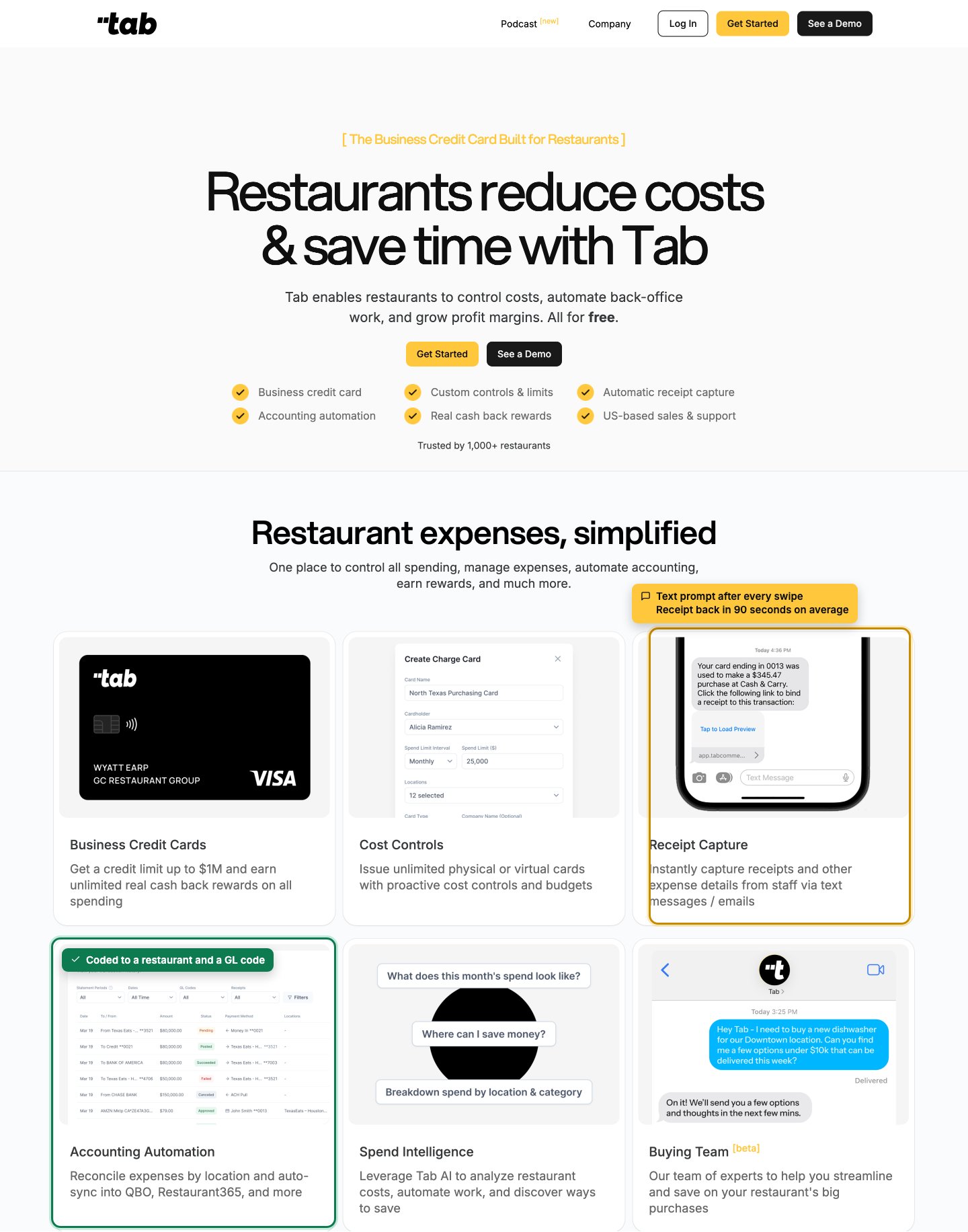
Tab keeps missing purchases and invoice errors from distorting the food-cost number you act on.
Questions operators ask about food cost
Build it from your P&L: 100% minus labor, occupancy, other operating costs, and required profit. Your trend against your target matters more than another concept's benchmark.
Monthly for accounting, weekly for action. Weekly counts on high-value items catch price and portion problems before the period closes.
Theoretical is what recipes and sales say you should have used; actual is what counts and purchases say you used. The gap points to waste, over-portioning, yield loss, or theft.
Yes. Mix can shift, yields or portions can change, comps can rise, or an invoice can land in the wrong period. Same prices, different number.
Price checks, credits, receiving, yields, waste logs, and comp audits recover money without changing the plate. Shrinking portions should be a later lever, not the first.


